Otter be working!

Sunday, May 24, 2015

Midnight in Paris vs. Paris in the Twentieth Century

Juxtaposing Woody Allen’s Midnight in Paris with Jules Verne’s newly discovered work, The Lost Novel: Paris in the Twentieth Century

Rosy-tinged, nostalgic 1998 vs. Stressful modern times 2014
Given the opportunity, would you rather live in a historical golden age or a future dystopia?

The question arose after Kenneth and I visited the National Art Gallery in D.C. I complained that the curator of the museum had arranged some fine pieces of Renaissance, Dutch, Impressionist, and Abstract art in a senseless hodgepodge manner. The museum felt like a dizzying maze of glass and marble corridors that jerked us back and forth in time, almost like time travel.

The jolting art viewing experience reminded me of Owen Wilson in Midnight in Paris being transported into the Jazz age, and how the private detective chasing Wilson ends up in 18th century Versailles’s Hall of Mirrors.

According to Prof Feldt, there was no sense of public cleanliness in the 1700's, and people often pooped in the Hall of Mirrors without batting an eyelash...
In case you have not watched Woody Allen’s fantastic Midnight in Paris, I recommend that you spend an evening doing so before reading my spoilers. Wilson, a writer and a romantic, roams the streets of Paris and settles on the front steps of the church St. Etienne du Mont. Once the bells strike twelve, a vintage Peugeot passes and grumpy-pants Hemingway invites Wilson for a drink. Because Wilson apparently isn’t drunk enough to believe he just got whisked back into the roaring 20’s, his favorite time period.

Every evening, Wilson returns to the past to dine with a concentrated cluster of intellectuals and artists from the “Lost Generation,” ranging from the crazy Fitzgeralds to Picasso to Dali. Everything in this era is as perfect as Wilson imagined, so much better than the insufferable superficiality of current times. However, Wilson’s love interest, Marion Cotillard, disagrees. She longs for the Belle Epoch.

And no, time travel via St. Etienne du Mont at midnight does not work in real life. Trust me, my sister and I've tried it.
When I asked Kenneth (not my love interest lol) about which age he would choose to live in, he similarly chose La Belle Epoch. A political science buff, he finds politics to be at its most fascinating then because the world powers naively believed they were at the peak of civilization, despite being at the brink of the first World War that would prove them oh-so utterly wrong.

Yet upon meeting Degas and Toulouse-Lautrec from the Belle Epoch, Wilson learns that they idealize the Renaissance as the Golden Age. No need to keep on time skipping, Wilson soon realizes that nostalgia never ends and that he should appreciate the present before it slips away.


Kenneth turned the question on me. Even though I would love to jump back into my childhood shoes and relive such carefree days, I would never want to live in a previous time period. Maia once explained to me that she would choose which time period to live in depending on whether she could control her ethnicity, status, geography, or gender. For instance, life has historically sucked for females in general. As unequal as it still is, gender equality is much better now than ever before.

Instead, since I was young, I have always wanted to peek into the future and discover all the cool new gadgets and inventions we’ll have. Maybe research will have cured cancer, maybe we will all have teleportation telephone boxes, or maybe we will be living underwater. A true sci-fi lover, I am always fantasizing about what the future holds.

That’s why I was so excited to find that one of my favorite writers, Jules Verne, accurately depicted the twentieth-century as early as 1863 in his lost novel, Paris in the Twentieth Century. I call it “lost” because it was never published until 1994. Verne’s publisher read, scorned, and turned away the manuscript for being so “unbelievable.” 

Do elevators, skyscrapers, radios, cars, 24-hour convenience stores, subway systems, the electric chair, airplanes, fax machines, and a rise in robots replacing people sound unbelievable to you? Verne particularly worried about the death of art and literature in a world overrun by capitalism and obsessed with progress. The protagonist, also a writer like Wilson in Midnight in Paris, notes: “Everyone can read, but no one reads books.”

The actual book is not a great read, but the fact that such prescience exists amazes me, along with books like George Orwell’s 1984 and Ray Bradbury’s Fahrenheit 451. Still, as you might notice, books that anticipate the future often have a bleak backdrop. Do technological advances necessarily come with drawbacks? (iPhone, I’m looking at you…)

We’d have to look back in history to answer that question. Though we can’t always predict what consequences our decisions and creations will have. At the end of the day, I concluded with Kenneth, Maia, and Woody Allen that the most exciting time to live is the current one. Especially as an aspiring physician-scientist, I don’t see the value in cheating by leaping into the future and just seeing the results anymore. There’s no real fun or reward in that. I want to be the one discovering something new and directly shaping how the future will look like through the present. Even if that is yet another idealistic view...

"That's what the present is. It's a little unsatisfying because life is unsatisfying." Midnight in Paris, Woody Allen

Tuesday, May 12, 2015

Otter Keep Your iPhone Away From Me!

OtterBox iPhone cases aren't otter-proof, so it turns out...

Round 1: Angry real otter vs. an otter-wannabe box (1-0)
With a blog name like mine, it seems that I otter attempt to cover all things like this: A zoo-goer with clumsy fingers, quite like myself, tried to snap photos of some feisty river otters at the Red River Zoo in Fargo, ND. Instead, the iPhone, which was wrapped in an OtterBox phone case, took a dive and joined the otters for a refreshing afternoon swim.

"Will this affect our marketing strategy?"
A certain otter took issue with the imposter. It promptly tore up the plastic case to pieces, flung the iPhone into the water, dipped back in to pick it up, and then repeated the iPhone bashing process. Seems like OtterBox gave a false impression of being on friendly terms with real otters...


Dropping your phone in the river or at a zoo is never a good idea, since it can actually be a choking hazard to marine mammals... But I think this otter was right to be furious at iPhones and smart phones for another reason.

iPhones often suck the life out of people. I have recently been reflecting on my life as one example... I check Facebook religiously, walk with my iPhone shoved in my face such that I accidentally run into walls, doors, elevators, and people without making eye contact, and even experience "phantom vibration syndrome" (which is where people constantly think or feel like their phone is vibrating/ringing). When I'm trying to talk to someone, but their eyes are glued to their phone, I feel as though I am uninteresting. So then I get on my phone, looking for something to create a real conversation. I forget to turn my iPhone on silent before bed, so right when I've finally slipped into sleep, a flurry of texts from the West Coast at 3 am my time brings me right back to square one in my struggle to fall asleep...

Truthfully, I love how connected I can feel to friends and family from across the world with my smart phone's ability to show me anything anytime anywhere. I could never imagine my life without an iPhone anymore. But I think that's sometimes a problem. There are times when I just need to unplug myself from the interconnectedness of the world, go out for a quiet and undisturbed walk to admire some otters with my naked eye rather than through the filtered lens of my iPhone...

Now, let me sum up this thought with this article about how smartphones are ruining our lives that I saw posted on Facebook...

Monday, April 27, 2015

Do You See L.A. Brewing in My Tea Leaves?

Yes, I am capable of worse puns...like: have you ever seen a bear bruin tea?

From Newspaper to Med School buddies!
My usual morning. Snoozed my PTX song alarm a few too many times. Forgot the important letter I needed to send today on the kitchen counter, dashed back to get it, but then missed the 9:20am Metro train. Of course, Metro trains start taking their leisurely time after 9:30am, so I tried to sneak into lab from the backdoor. Got caught by the post-doc sitting next to me anyways.

Who, by the way, asked me something that I am itching to tell him to never say to his daughter during her teenage years in the future. Though he honestly meant well. He was just trying to point out how tired I looked.

True, the past few weeks, months, and probably entire year, have been a strenuous ride. That will go without saying for anyone applying to medical school. The whole process is like the college Common App on steroids. You need a lot more grit and some lofty numbers to hold your ground. In the primary application, you hack away at a personal statement and then pick the schools you want to apply to, no problemo. When each school sends its secondary application, which includes an outstretched palm often asking for >$100 and a flood of mini-essays (especially for MD/PhD programs), you might feel like you're drowning. Once I am brave enough to reread them, I actually do want to drown myself in the Potomac river that I renamed the "Pontomac," and for issuing a new government program called "Medicard."

Then there's dreaded silence. I often couldn't focus on my work because of the fear that I would hear silence forever. One by one, precious interview emails start trickling in like rain in a desert.

First interview. I have to dress like I'm going to a funeral but smile until my cheeks hurt. Walk from office to office until my flats or heels drag like sodden clogs, and fervently nod my head because of how fascinating a professor's research sounds, when really it's putting me to sleep. My body is sore and stiff from constantly feeling evaluated by eyes I can or cannot see. Repeat several times over the span of 4-5 months.

The silence returns. I have nightmares about the MCAT. I wonder if silence is better than rejection. I wonder if silence is rejection. And for several schools, it is. They just don't get back to you... or maybe I just forgot to submit my secondary properly?

With so many outstanding applicants, medical schools are bound to reject students who were plenty qualified. But it still hurts. And is really confounding sometimes. I'm frustrated by the number of crosses on my list of applied/interviewed schools. No circles yet, and I'm already down to 3 schools out of a dozen...

Rejections from dream schools, safety schools, random schools... they make me question my worth, my intelligence, my conversation skills. I begin to doubt the amount of sweat, tears, and mouse blood I have shed for the sake of my passion to slave away at medicine and research for 15+ years.

While reflecting, I realized that the uncertainty I felt was something new to me as a premed, who has followed a clear curriculum and specific goals for 5 years, but was familiar to my peers looking for a post-grad job. I had been looking at medical school as an end-goal, as if once I got in everything in my life would be set. When really, this process was preparing me for the sort of challenges I would experience after graduating from graduate school in another 8 years from now.

The moment I stopped looking at my life as a check-list, something wonderful fell into my lap. Two acceptances to two schools where I felt most at home, and wait-listed at my dream medical school. I felt a burden being lifted from my shoulders, it was amazing.

And that's when a new dilemma arose. By April 30th, I could only have one of those beautiful, glittering schools on my plate, but I sincerely wished I could go to all three. Two schools invited me to return. They wined and dined me from daybreak to twilight. I have never felt so important in my life. I have never met so many inspiring professors and fun and intelligent peers as I have in the past two weeks.

I passed up Stanford, my dream medical school, for the security of the MD/PhD program, but now I was left with the very same two schools I had battled between for undergraduate school: The University of Chicago (the school I fell in love with at first sight and continue to love dearly) and UCLA (which is over an hour away from where my family lives). I knew I would be happy and sharpen a successful career at either. Agonized, I tore up my hair (literally) while trying to choose one.

The letter I forgot, dashed back for, and finally mailed out this morning, was sent to UChicago. It was the more difficult letter to send. In the afternoon, I quickly wrote a much more joyful letter to UCLA. Of course, I managed to spill chamomile tea all over it as I rushed to the mailbox right before the mailman arrived... All I can say is, I have decided where I will be the happiest and that decision better not change for another 8 years!

"Folks are usually about as happy as they make their minds up to be." Abraham Lincoln

Saturday, April 25, 2015

The Ebb and Flow of Memories: The Ocean at the End of the Lane

My childhood memories mainly consist of me being somewhere, eating something.

The ebb and flow of memories at The Ocean at the End of the Lane: A Novel by Neil Gaiman


Mild spoilers ahead...

Where does your childhood memory start? For Neil Gaiman's unnamed protagonist, he recalls the empty seats at his seventh birthday party. As I would have done, he crawls upstairs to escape into some C.S. Lewis adventures, "Books were safer than other people anyway." Reminds me of my own seventh birthday party. My friends clamored to sit next to my best friend instead of the birthday girl. I felt pretty bummed, I wanted to sit next to my best friend too. I suspect that Gaiman did not name his protagonist and drew on some of his grim childhood experiences when writing this book, because he initially wrote this work as a short story dedicated to his wife, the quirky artist/singer Amanda Palmer.

It took me a while to understand that birthday candles are not always yours to blow...
If you are any familiar with Gaiman's work like Coraline and American Gods, you would know how effortlessly he threads dreamlike fantasy into the seemingly everyday. The result can be rather unsettling, especially since the enemies in The Ocean at the End of the Lane hit close to home, literally. A sinister power manifests itself as the unwelcome strangers in the protagonist's house who make his life miserable, like the suicidal gambler who steals his father's car, and a pretty nanny who seduces his father and wins his younger sister's affection.

With his family turned against him, the protagonist runs away and receives shelter in the warm abode of the magical Hempstock family. Grandma, Mother, and (a girl his age) Lettie Hempstock are all strong-willed and kind. They protect him from evil entities and help him find his way while he tries to adjust to big changes in his life. Lettie Hempstock is particularly sweet, though the protagonist finds her quite eccentric for insisting that the small pond by the Hempstock farm is an "ocean." An ocean, the protagonist later finds out, that is much like the tremendous yet fleeting feeling you get when you wake up from a dream where everything suddenly makes sense...but then quickly forget.


The Ocean at the End of the Lane reminds me a lot of Pan's Labyrinth, because in both, I feel like the stories can be interpreted as protagonists trying to deal with horrific incidences through fairytale-like magic. War or threatening strangers have destabilized their sense of belonging, so they use magic to forge a new story, a new reality, and a new identity. Hence, the power of myth and Gaiman's craft as a storyteller.

The way the story unfolds through the hazy lens of the adult protagonist slowly remembering his hurtful past, really made me feel as though I was reliving a long-lost memory. I especially love Gaiman's portrayal of adults in his book. He shows that all adults, even the monsters that haunt the protagonist, actually share similar uncertainties and fears. Their actions have consequences that they did not intend and cannot control. As Lettie explains, “Grown-ups don't look like grown-ups on the inside either. Outside, they're big and thoughtless and they always know what they're doing. Inside, they look just like they always have. Truth is, there aren't any grown-ups. Not one, in the whole wide world.”

The adult protagonist reflects on his rather drab life until now, about his divorce, his children who he never really sees, his job, a recent funeral... he wonders why the ocean brought him back to remember everything.

"Why did she bring me here?"
"I think she wanted to know if you were worth it," the old woman said.

[Long pause...] "Did I pass?"
The face of the old woman was unreadable in the gathering dusk.
"You don't pass or fail at being a person, dear."

So when work is hard, an experiment doesn't work, someone I love has hurt me or vice versa... I'll look back on my rich childhood memories, remember the sacrifices other people have made for me to have a better life, and realize that nobody else has had the same experiences I have had. Nobody on earth can judge my life, not even me. And so I get up and keep going, leaving behind those memories buried in the recesses of my mind until I need them again.

Tuesday, March 31, 2015

I Mustache You: Does this hair make me look like a man?


A Review of Cross-dressers who Fooled No One


In honor of April Fool's Day, Disney announcing a live-action Mulan (crosses fingers), and dramas where pretty girls unconvincingly cross-dress... I cut my hair to make myself a mustache/beard.


Just kidding. I didn't keep the gnarly beast-tail for cosplay. I'm donating the 12" and 3 ounces to Locks of Love, in hopes that they'll use some to build a wig for children with cancer or alopecia. Or at least sell the unusable dyed/permed strands to fund alopecia research. Which would hopefully come back full-circle, as I currently work in a lab that studies hair and teeth disorders!

What is alopecia areata? Basically, children begin to bald at a young age because their immune cells mistakenly attack the hair follicle cells. The cyclical nature of hair follicle cells causes all hair to eventually fall out and regrow. But not so when follicle cells die permanently.

Are you interested in donating? Then I recommend donating to Pantene Beautiful Lengths instead of Locks of Love. After reading some articles, I noticed that Locks of Love takes forever to manufacture wigs, throws away or sells most donated hair, and gives wigs to families at a "discounted" price. Pantene Beautiful Lengths, on the other hand, partners with a specific wig company and American Cancer Society, which distributes the wigs to those in need for free. A much more efficient system, and they only require 8" of hair. They just don't accept chemically treated hair, which I had.

As regards to the new look, my hair dresser kept looking over at me with concern and asking, "Are you sure? Are you sure? Are you really sure?"

I firmly nodded for her to hack the heavy mop. And with a long, loud snip! I was finally free of the heavy and difficult varmint.


Unlike Mulan, I cannot say that I adopted an alter ego with a single chop, but I feel lighter and more refreshed. Even though an outer appearance shouldn't define you, it can certainly shape how you feel about yourself.  

Before, I always felt uneasy about having short hair. People associate longer hair with femininity. So as a tomboy, I used to be afraid that I would look even more like my brother. But with 2015's runner-up Miss Universe flaunting her unique cropped look among all the other Misses, and my own long hair becoming quite the hassle... I now know that having short hair is quite the bomb.

Here are a few other stars who tried to conform to a "boyish" look for a typical cross-dressing story, but their girly charm still shines through the short locks.

http://www.dramafever.com/st/img/wp/2010/08/CP.jpg1. Yoon Eun-Hye: 1st Shop of Coffee Prince

Practically everyone at the coffee shop could tell Eun-Hye was a girl, except for the boss "who freaked out because he thought he was gay." Or maybe you need to get your eyes checked for not noticing Eun-Hye's boobs earlier. I have to say though, Eun-Hye's portrayal of a cross-dressing tomboy is the most convincing out of all the other dramas I have seen. And that's what makes her Coffee Prince one of my favorites of all time.

My addiction to dramas did not start from Yoon Eun-Hye's coffee, but her palace life in Goong. Tiptoeing downstairs with my mom to watch each episode every Wednesday night at 11pm was the harbinger for countless of future sleepless nights spent on >16 hours of vapid soap operas...

https://michellesinclair.files.wordpress.com/2012/02/go_mi_nam_youre_beautiful__05052010044815.jpg2. Park Shin Hye: You're Beautiful

The story in You're Beautiful is practically irrelevant. From the start, everyone knows she's a girl. The true charm to the drama is that the amazing, easy-going Park Shin Hye is just chilling out and having a blast with three good-looking guys her age. One of which she actually ends up dating IRL... Second-lead syndrome finally upended!

Park Shin Hye has been my girl crush for more than 7 years. Christina and I keep trying to win her hairstyles, but someday I will just have to accept that my hair, my clothes, and my life will never look as perfect as hers! :P


3. Horikita Maki: Hana Kimi

Horikita Maki wears this short hairstyle all the time anyways. So surprise, surprise, now she's a "boy." The real reason why these actresses with short hair can pull off looking like boys, is probably because Asian actors have girly hair.

Hana Kimi is my least favorite cross-dressing drama of the three. I would definitely pick her "debut" drama, Nobuta Wo Produce or the Hana Kimi manga over this hot mess of a Jdrama any day.

Mulan: "Who is that girl I see?... Why is my reflection someone I don't know?... When will my reflection show who I am inside?"

"Maybe I just wanted to look in the mirror and see someone worthwhile... But I was wrong... I see nothing!"

disney animated GIF

Mushu: "Now that's just because this needs a little spit, that's all. Let me shine this up for you."

Thursday, March 26, 2015

Rekindling Classics as Comics: Ray Bradbury's Fahrenheit 451

Ray Bradbury's Fahrenheit 451: The Authorized Adaptation - Illustrated by Tim Hamilton


I love to flip through familiar paperbacks in B&N to catch my favorite scenes, like a distracted middle-schooler's Post-It flip book. So imagine my delight on Saturday when my eye caught an illustrated version of Fahrenheit 451 validated by the prolific Bradbury himself! 


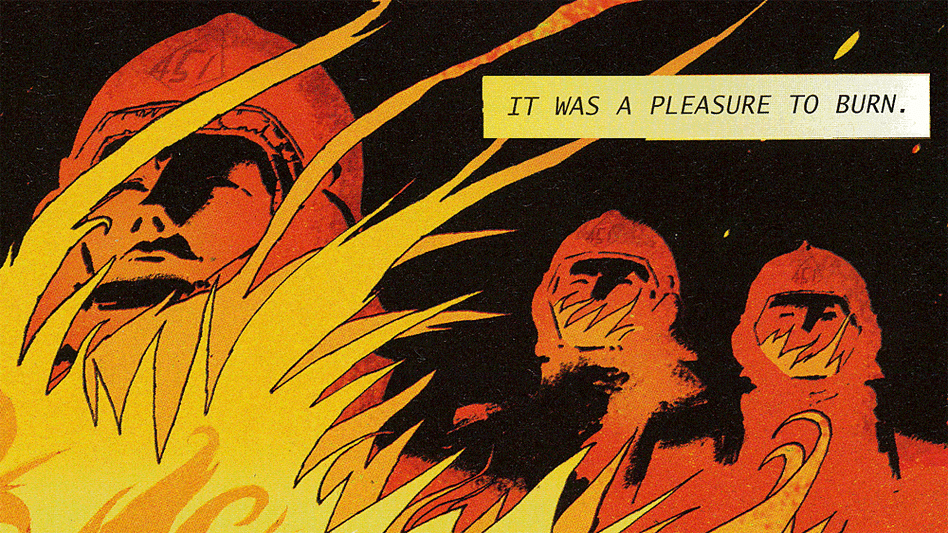
Tim Hamilton, the artist, is no Alan Moore, but his angular style does capture Guy Montag's ruggedness and the book-less world's insipid and stifling landscape. Considering how terrible movie adaptations have been, I was actually pretty impressed by how well the comic book's fast visual pace fit Bradbury's effortless dialogue.

Especially with beautifully written books like Fahrenheit 451, where I actually feel flames licking at the corners of the pages and Clarisse rubbing a soggy dandelion under my chin to see whether or not I'm in love; smell Guy doused in cursed kerosene; hear a Seashell tickling my ear (Bradbury's technologic prescience always amazes me); and see Clarisse's thin, white silhouette in an oppressive, starless cityI often think that no one could direct these moments better than my own mind.


But reading this comic book actually helped me grasp key parts of the book that slipped my memory or flew over my head when I was younger. And all in less than half an hour. 

For instance, Clarisse's oddball scenes and quirky dialogue has always stuck with me, as it does with Guy. Meanwhile, I never clearly understood Mildred's depressive suicidal attempt and her swift, but gruesome medical surgery, because Mildred herself does not recall it and waves it away, replacing it with empty wall-talk. 

(Random connection: Mildred's vapid concentration on her brainwashing shows while chugging pills reminds me of the crazy guy Mink from Don DeLillo's White Noise).

Also, I loved Captain Beatty's quote parrying scenes, his maniac obsession and love/hate relationship with books really jumped out at me between panels. I have always wondered if Beatty is aware of the power that literature has, but wants to keep that power to himself or is afraid of allowing it to spread to the masses.

In any case, if you happen to be looking for a quick refresher on Bradbury's classic or are trying to get your book-averse cousin to read something more substantial than the tiles in "Candy Crush," I recommend browsing through this adaptation. I do love the irony that a book about how instantly gratifying media might threaten the traditional form is being faithfully retold to reach a new generation of readers on the brink of Bradbury's greatest fear...

"We have everything we need to be happy but we aren't happy. Something is missing...
It is not books you need, it's some of the things that are in books. The magic is only in what books say, how they stitched the patches of the universe together into one garment for us." — Ray Bradbury, Fahrenheit 451

Tuesday, March 24, 2015

Hooking the reader with the ending: The Secret History

The Secret History (Donna Tartt) Review

Does knowing how a story ends necessarily spoil the story? Especially for a murder mystery, you would expect that knowing the culprit would ruin the intrigue. So when mastermind Donna Tartt revealed everything from the get-go, I was utterly baffled. She broke the rules I thought existed in the mystery genre, yet instantly had me hungry for more.

So now let me spoil the story for you...

https://flavorwire.files.wordpress.com/2014/01/9780141023649_custom-ae6ae36c705c309cfd9247dc8c2688bba5c26bcc-s6-c30.jpg

Tartt shares that a group of friends purposefully push their buddy Bunny off a cliff right before April snow so that everyone believes it is just an accident. She baits us with one key missing piece of information: why? 

And all this in a two-page prologue that I might have skipped if it had not been assigned by my professor. Yes, I am guilty of skimming through prologues. Aren't we all? I often assume that there cannot be enough information or substance in such a short frame. Prologues set the tone of the story and feed the reader unsatisfying crumbs. But the best prologues give readers enough to anticipate that this book will deliver a story to remember.

And Tartt delivers.

But not if you are looking for a typical murder mystery or a thriller of any sort.
 
The Secret History honestly reads more like a coming-of-age novel, a J.D. Salinger set in a lush New England backdrop at a liberal arts college campus. The first-person narrator, Richard Papen, has a vice for the opulent life and a talent for fibbing.

What really struck me odd and Salinger familiar was Papen's casual voice. In fact, each key character has a nonchalant shrug-off attitude towards everything in life, except Greek studies and booze. The very first lines of the prologue might demonstrate that better.

"The snow in the mountains was melting and Bunny had been dead for several weeks before we came to understand the gravity of our situation. He’d been dead for ten days before they found him, you know."

Right before Bunny is killed, the hunter and hunted have the most alarmingly understated conversation in betrayal history.

"What are you doing up here? said Bunny, surprised, when he found the four of us waiting for him.
Why, looking for ferns, said Henry."

More about the characters. The narrator, Richard, lays clear his desires and motivations from the first chapter, but it took me longer to warm up to his character. I can see why he tries to lie his way through everything, he is afraid his bland background and personality will bore everyone and himself to death. So he contrives a fancy upbringing that traps him later.

The other five characters consist of two of the sweetest, most gorgeous but fatal twins, a dandy, a hyperactive and overly charismatic Bunny, and the reticent yet imposing Henry.

Henry, by far, was my favorite character. Also the most puzzling. Sometimes I think he's the true star, a Gatsby, while Richard is Tom, the observing side-narrator. He says so little, his movements are so simple, and his attitude so blasé, that everything about him carries so much weight. He is the only character in the story to fall with grace. Even though his pride breaks, it ends somehow intact.

Meanwhile, Bunny is Richard's foil. Their circumstances are so similar, yet they approach life in polar opposite directions. Richard hides the truth, Bunny touts the truth too loud. But Bunny's death does not stop his suffocating reach. Bunny does a good job of haunting his friends from the grave.

For the final, most crucial question to address: why would friends kill a fellow friend? 
 

Skip my answer if you want to find out yourself. Go buy yourself a copy of Tartt's novel right now.


Read on only if you won't read the book and trust that none of your friends would ever murder you.

Simply because they were close friends. Too close of friends. The littlest things can pile up between close friends. And there are some things you prefer to not be known by others.

Ironically, Bunny's death is the very catalyst for their dark secrets to bubble up to the surface and explode. Without Bunny, their actions and mentalities become more unrestrained, unchained, and things. fall. apart.

So lesson learned. Don't rip your friends apart just because they know you too well, you won't be able to sleep at night anymore.

Will my spoiling the secrets of The Secret History keep you from reading the book? Trust me, these are the least important surprises that this book holds. I hope this review only entices you to embark on this haunting narrative of the snowballing mistakes a few kids made in search for a surreal experience. Because I guarantee you will experience one of your own through Tartt's evocative imagery and clever storytelling.

Fortunately, not one you'll regret. 

"I suppose at one time in my life I might have had any number of stories, but now there is no other. This is the only story I will ever be able to tell." Richard Papen Donna Tartt, The Secret History (2004)

4/5 You Otter Read This Book Stars