Juxtaposing Woody Allen’s Midnight in Paris with Jules Verne’s newly discovered work, The Lost Novel: Paris in the Twentieth
Century
 |
| Rosy-tinged, nostalgic 1998 vs. Stressful modern times 2014 |
Given the
opportunity, would you rather live in a historical golden age or a future
dystopia?
The question arose
after Kenneth and I visited the National Art Gallery in D.C. I complained that
the curator of the museum had arranged some fine pieces of Renaissance, Dutch,
Impressionist, and Abstract art in a senseless hodgepodge manner. The museum
felt like a dizzying maze of glass and marble corridors that jerked us back and
forth in time, almost like time travel.
The jolting art
viewing experience reminded me of Owen Wilson in Midnight in Paris being transported into the Jazz age, and how the
private detective chasing Wilson ends up in 18th century
Versailles’s Hall of Mirrors.
 |
| According to Prof Feldt, there was no sense of public cleanliness in the 1700's, and people often pooped in the Hall of Mirrors without batting an eyelash... |
In
case you have not watched Woody Allen’s fantastic Midnight in Paris, I recommend that you spend an evening doing so
before reading my spoilers. Wilson, a writer and a romantic, roams the streets
of Paris and settles on the front steps of the church St. Etienne du Mont. Once
the bells strike twelve, a vintage Peugeot passes and grumpy-pants
Hemingway invites Wilson for a drink. Because Wilson apparently isn’t drunk
enough to believe he just got whisked back into the roaring 20’s, his favorite
time period.
Every evening, Wilson
returns to the past to dine with a concentrated cluster of intellectuals and
artists from the “Lost Generation,” ranging from the crazy Fitzgeralds to
Picasso to Dali. Everything in this era is as perfect as Wilson imagined, so
much better than the insufferable superficiality of current times. However,
Wilson’s love interest, Marion Cotillard, disagrees. She longs for the Belle
Epoch.
 |
| And no, time travel via St. Etienne du Mont at midnight does not work in real life. Trust me, my sister and I've tried it. |
When I asked Kenneth (not my love interest lol) about which age he would choose to live in, he similarly chose La Belle Epoch.
A political science buff, he finds politics to be at its most fascinating then because the world powers naively believed they were at the peak of
civilization, despite being at the brink of the first World War that would prove
them oh-so utterly wrong.
Yet upon meeting
Degas and Toulouse-Lautrec from the Belle Epoch, Wilson learns that they
idealize the Renaissance as the Golden Age. No need to keep on time skipping,
Wilson soon realizes that nostalgia never ends and that he should appreciate
the present before it slips away.

Kenneth turned the
question on me. Even though I would love to jump back into my childhood shoes
and relive such carefree days, I would never want to live in a previous time
period. Maia once explained to me that she would choose which time period to
live in depending on whether she could control her ethnicity, status,
geography, or gender. For instance, life has historically sucked for females in
general. As unequal as it still is, gender equality is much better now than
ever before.
Instead, since I was
young, I have always wanted to peek into the future and discover all the cool
new gadgets and inventions we’ll have. Maybe research will have cured cancer,
maybe we will all have teleportation telephone boxes, or maybe we will be
living underwater. A true sci-fi lover, I am always fantasizing about what the
future holds.
That’s why I was so
excited to find that one of my favorite writers, Jules Verne, accurately
depicted the twentieth-century as early as 1863 in his lost novel, Paris in the Twentieth Century. I call
it “lost” because it was never published until 1994. Verne’s publisher read,
scorned, and turned away the manuscript for being so “unbelievable.”

Do elevators,
skyscrapers, radios, cars, 24-hour convenience stores, subway systems, the
electric chair, airplanes, fax machines, and a rise in robots replacing people
sound unbelievable to you? Verne particularly worried about the death of art
and literature in a world overrun by capitalism and obsessed with progress. The
protagonist, also a writer like Wilson in Midnight
in Paris, notes: “Everyone can read, but no one reads books.”
The actual book is
not a great read, but the fact that such prescience exists amazes me, along
with books like George Orwell’s 1984
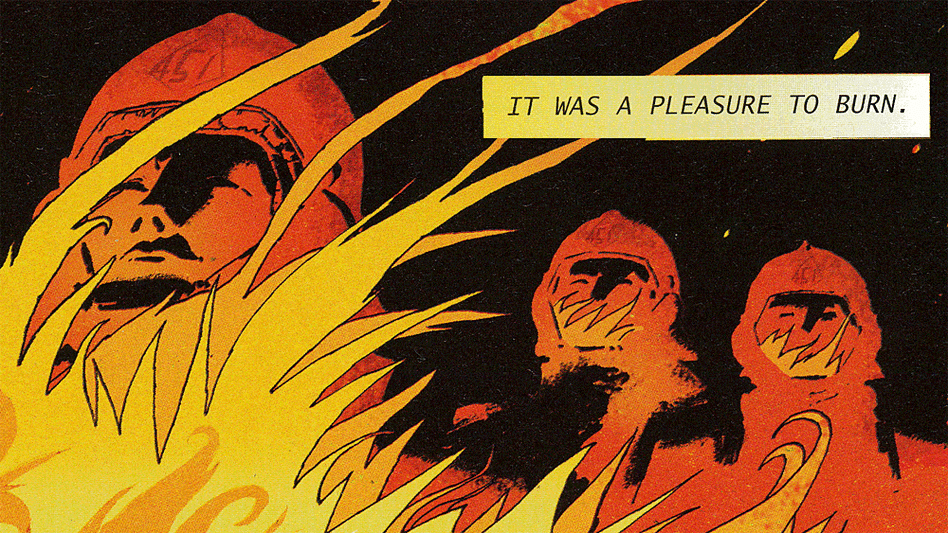
and Ray Bradbury’s Fahrenheit 451.
Still, as you might notice, books that anticipate the future often have a bleak
backdrop. Do technological advances necessarily come with drawbacks? (iPhone,
I’m looking at you…)
We’d have to look
back in history to answer that question. Though we can’t always predict what
consequences our decisions and creations will have. At the end of the day, I
concluded with Kenneth, Maia, and Woody Allen that the most exciting time to
live is the current one. Especially as an aspiring physician-scientist, I don’t
see the value in cheating by leaping into the future and just seeing the
results anymore. There’s no real fun or reward in that. I want to be the one discovering
something new and directly shaping how the future will look like through the
present. Even if that is yet another idealistic view...
"That's what the present is. It's a little unsatisfying because life is unsatisfying." — Midnight in Paris, Woody Allen